Why is Paul so Hard to
Understand?
by Frank Guasto
I
can’t understand Paul!
I agree and believe that there are valid reasons
for taking such a position.
In order for us to a set solid foundation in our
thinking we have to understand that Paul was a Pharisee and by Paul’s own admission he continued honoring
most all of the traditions of the Pharisee’s and continued on in such
traditions as evidenced by the scriptural references shown below.
However, to understand Paul we must separate the
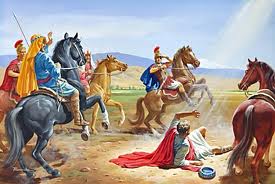
“Old Paul from the New Paul.” The Old Paul became the New Paul when on the Road to
Act 26:5 Which knew me from
the beginning, if they would testify, that after the most straitest sect of our
religion I lived a Pharisee.
Phl 3:5 Circumcised
the eighth day, of the stock of Israel, [of] the tribe of Benjamin, an Hebrew
of the Hebrews; as touching the law, a Pharisee;
Adding more difficulty to the Eastern/Western ideologies
is the problem of translation. When the Scriptures are read in the English we
are not always getting an accurate extraction of its original meaning from the
Hebraic mind perspective. Without a doubt, the more the filtering of languages,
the more chance for misinterpretation to occur.
To understand Paul, I would strongly recommend
setting Scriptural Anchors as an immovable foundation, firmly established in
Torah, God’s teaching and instructions.
May I suggest that, a reason for Paul seemingly
being so difficult to understand is due to the dismissal or non recognition of
what I choose to call “Biblical Scriptural Anchors.” Over many years, man made
dispensational denominational philosophy has crept in, replacing the unchanging
full counsel of Biblical truth. The incremental erosion and departure from the
faith, once given the saints, comes at a time in history when our LORD is, in
my view, getting prepared to gather His people,
ANCHOR #1
Eph
2:8
For by grace are ye saved through faith; and that not of yourselves: [it
is] the gift of God:
Eph
2:9 Not of works, lest any man should boast.
Eph
2:10 For we are his workmanship, created in Christ Jesus unto good works, which God hath before ordained that we should walk in them.
There should be no argument that these verses
advocate that salvation is By Faith apart from Works, but this
passage does go on to tell us to perform Good Works. These Good Works were established from “Ancient Times,” and are the commandments contained in
the Torah.
The Torah is so much more than what we see from
the English word “law.” A more appropriate description for the Torah would be “God’s
teaching and instructions for righteous living.” The tenets for righteous
living given in the Torah are for believers who have entered through the door
of salvation by faith alone. Therefore, the Torah has been set in place by God
for believers only, and is not meant for unbelievers.
This is why we should look to the “Abrahamic
Covenant” experience as the pattern of being born again through faith coming
through the unilateral promise from God alone. (Gen 15:9-18) The “Mosaic Covenant” is a bilateral
agreement made between two parties to perform the provisions of the contract.
This Mosaic Covenant is the marriage contract (ketubah) made between God and
man at Sinai. The marriage contract is not the Torah itself, but is the
agreement (I do!) to keep the Torah, which is the Law of Moses.
ANCHOR #2 Rom
3:31 Do we then make void the law (Torah) through faith? God forbid: yea, we
establish the law (Torah).
This agrees with
James 2:17 Even
so faith if it hath not works is dead.
James 2:24 Ye
see then how that by works a man is justified and not by faith alone.
Works is the proof of ones faith, and is the
witness that it is genuine, by speaking and acting in behalf of YHWH’s Torah
and not that of doctrine’s of men. The works to be assigned to the believer has
been predetermined before the foundations of the world. By grace through faith
you are saved to do good works as God as beforehand preordained, as it is
written in (Eph 2:10)
Above anything else we must indelibly etch into
our memories that Paul has never advocated that the Law of Moses (Torah) has
been done away with. The Torah is God’s eternal decree, never to be broken, and
by attempting to do so we are inviting temporal as well as
eternal judgment from the Throne of Grace. .
If we have even the slightest notion that Paul is
leaving the Torah behind,….Think Again!…. because the problem is not with Paul,
it is with our misguided ignorance of the Scriptures.
My friend Brad Scott repeatedly states that “Words
Mean Things.” If we do not understand how a word or term is used contextually
in any given expression we can easily be misled. This should not be difficult
to take hold of! Nevertheless, I will do my best in explaining these terms and
their meaning as they appear in their specific context.
When
we are reading the Scriptures in English we may not be aware that we are not
always receiving an accurate account of what is being said due to the text
being filtered through Greek etc. to English. Because of this, it makes it even
more difficult to understand Paul’s writings than it was in Peter’s day.
Peter’s statement in (2Pe 3:16) tells us that Paul is hard to be
understood. So, if it was difficult for Peter to understand Paul, how much more
for us?
The word law in the
English is somewhat generic in that it does not provide the words specific
meaning as it is being used in each of the entries of the text. In the Greek, the Word for “law is Nomos” and
in the “Hebrew is Torah.” Torah can be law as well as nomos, but Torah is much
more than that, because in it contains the fullness of God’s teaching and
instructions from the Hebraic perspective for righteous living.
We can only begin to understand Paul by examining
his point of view before and after his conversion. After his conversion Paul
was having difficulty with judaizers, who insisted gentiles coming into the
faith could only be saved by first becoming converted to their traditions. They
first had to become part of what they considered to be a covenant people in
order to be eligible for salvation through Messiah. This conversion included
physical circumcision and the circumcision of accepting the terms of the Oral
Torah as part of the Law of Moses/Torah. This was Paul’s pre-conversion
position.
ANCHOR #3 YHWH’s Word is unchanging just as He is
unchanging. He is the God of Mal
3:6 who does not
change, of Hebs 6:17 the
immutability of His counsel does not change, of Psa 119:89 For ever, O LORD, thy
word is settled in heaven, of Heb 13:8 Messiah Yeshua the same yesterday , and
today and forever and of Rev1:8 From Him which is, and which was and
which is to come.
The Father and the Son are one in perfect unity,
in perfect agreement and bound to their unchanging Word; unlike changing men
with their theological dispensational non-biblical inventions.
RECOGNITION OF TERMS:
The following are terms that are used in the
Scriptures, that tend to confuse us, in that we have the mistaken belief that
these terms have to do with the “Law of Moses” (Torah). The terms being
used are “The Oral Law, Oral Tradition, Tradition of the Elders, Manner of the
Law, Customs of Moses and Work’s of the Law.” They are not the written “Law of Moses.”
The Word tells us above all
things, get understanding.
Pro 4:7 Wisdom [is] the
principal thing get wisdom: and with all thy getting get understanding.
Before Paul’s conversion (Acts Chapter 6) we read that “there arose certain of the synagogue which is called [the
synagogue of the Libertines, and Cyrenians that came to falsely accuse Stephen of speaking blasphemous words against the holy place and the law
(nomos).
In (Chapter 8:1) Paul is consenting
to that which resulted in the stoning death of Stephen. His behavior at that
time was not unlike the judaizers, who believing to be saved, it meant first
being brought into the covenant of
Starting in Acts
Act
6:14 For we have heard him say, that this Jesus of
The word customs here is not a
reference to the “Written Law of Moses/Torah” as many have believed to be the
case! In the Greek it is ethos (St 1486) and it is to be
defined as just that, (a custom), any custom by any community, and certainly
not the specific “Written Law Of Moses.”
This is not to say that the customs in and of
themselves were all bad. In many cases non-biblical “rabbinical customs” have
proven to be beneficial much the same as many non biblical customs adopted by
the church. In any event whether good or bad these customs had nothing and has
nothing to do with salvation. But the custom we see here is just that…a custom.
From there we see Paul journeying to
Paul was unable to see after his Road to
Following this Paul traveled to
Gal
1:11 But I certify you, brethren, that the gospel which was preached of me is not after man.
Gal
1:12 For I neither received it of man, neither was I taught [it], but by
the revelation of Jesus Christ.
Gal
1:13 For ye have heard of my conversation in time past in the Jews'
religion, how that beyond measure I persecuted the church of God, and
wasted it:
Gal
1:14 And profited in the Jews' religion above many my equals in mine own nation, being
more exceedingly zealous of the traditions of my fathers. (the
oral Torah)
Gal
1:15 But when it pleased God, who separated me from my
mother's womb, and called [me] by his grace,
Gal
1:16 To reveal his Son in me, that I might preach him among the heathen;
immediately I conferred not with flesh and blood:
Gal
1:17 Neither went I up to
Gal 1:18 Then after three years I went up to Jerusalem to see Peter, and abode with him fifteen days.
Paul was emphatically clear in saying when he went
to Arabia, his theology was set straight, only by the revelation of Messiah
Yeshua, (vs11&12) separating man made laws, customs, manners
and traditions from the “Written Law of Moses/Torah.”
Then, in (Acts15:1-11) Peter is
addressing the belief of a certain sect of the Pharisees who insisted that it
was needful for those gentiles coming into the faith to be circumcised which
meant “physical circumcision and circumcised into Judaism” which of course
meant keeping the oral tradition as well as the Written Law of Moses. Peter is
refuting the position of the Pharisees, with Paul being in full agreement.
Definition below ………of mixing God’s Word
with Man’ doctrine.
Paradosis (St 3862) Of the body of precepts,
esp. ritual, which in the opinion of the later Jews were orally delivered by
Moses and orally transmitted in unbroken succession to subsequent generations,
which precepts, both illustrating and expanding the written law, as they
did were to be obeyed with equal reverence.
What we see in (Gal 2:16 through 3:11-18) is Paul explaining the same problem as was being addressed in (Acts
15:1-11)
MAN MADE LAW vs YHWH’s LAW
The terms Oral Tradition, Tradition of the Elders,
The Oral Law nor Oral Torah, I repeat, is not in any way the written “Law
of Moses”. They are instead man made tenets that were put upon the people
as to how to walk according to the doctrines of men. This phenomenon exists in
both Judaism and Christianity etc. to this day.
God’s Word is precise and an eternally closed
charter, without additions or deletions.
Deu 12:32 What thing so ever I
command you, observe to do it: thou shalt not add thereto, nor diminish from it. (Rev 22:18-19)
The “Written Law of Moses/ Torah” was given
to Moses by YHWH at Sinai. On this occasion YHWH did not instruct Moses to “Say to the children of
Exd
34:27 And YHWH said unto Moses, Write thou these words: for after the
tenor of these words I have made a covenant with thee and with
Exd
34:28 And he was there with YHWH forty days and forty nights;
he did neither eat bread, nor drink water. And he wrote upon the tables the words of the covenant, the ten commandments.
From
the time of his conversion Paul is in no way saying that one could be saved by
ANY of these rabbinical additions to the Torah. We must point out, once again,
that this includes the “Written Law of Moses” although the way to salvation by
faith is laid out in the Torah in (Gen 15:6.)
Back to …Acts 15:1 ethos (St 1486) being used
which has the exact verbal root and meaning as the word custom being used in (Acts 6:14).
From here we go to Acts 22:3 I am verily a man [which am] a Jew,
born in Tarsus, [a city] in Cilicia, yet brought up in this city at the feet of
Gamaliel, [and] taught according to the perfect manner of the law of the fathers, and was zealous toward God, as ye all are this day.
The
word manner of the law as it is used in this context has a wider
application. The Greek word here for manner is…. akribes (St 196) 1) exact, careful… 2) of the strictest sect: the most
precise and rigorous in interpreting the Mosaic law, and in
observing even the more minute precepts of the law and tradition.
Paul
served both the Torah of Moses and the Tradition of the Elders as he would
later explain to Agrippa in (Acts 26:4-5) about his loyalty to
the most exacting sect of their religion. This is later confirmed by Paul in (Galatians
1:14-15) Again, this was not about
salvation, only adhering to tradition.
Now
we go to the term “works of the law” that is found in (Gal 2:16,
3:2, 3:5 and 3:10). This is the very remote Hebrew Term “Ma Hassay
Ha Torah” which means “works of the law,“ and not the Law of
Moses/Torah which is the Teaching and Instructions of God.
Aside
from (Romans 9:32) which is used in another context, this phrase
cannot be found anywhere in the scriptures or the rabbinical writings. It
merely adds to the confusion of which law is being addressed. Paul was tutored
under Gamaliel and it was not from him. It was a HERESY. It came from the
Essene community at
The
Essenes (short version) were members of a Jewish sect living in
The Essenes titling themselves as The True Congregation
of Holiness set themselves up as ones who according to their understanding
interpreted how the Torah should be followed. Regulations were put in place and
evangelizing people to them was not done
The Essene Position
First Be circumcised and immersed
Second Commit
to the works of the law according to their understanding of how to apply Torah.
Third They would be taught outside the camp for one year before entering into salvation.
The Nazarene Position
First Trusting
faith in Messiah Yeshua
Second Commit to the Torah life style by faith, immersion
Third Circumcision
How
does one become justified?
Gal
3:10 For as many as are of the works of
the law are under the curse: for it is written, Cursed [is] every one that
continueth not in all things which are written in the book of the law to do
them.
Gal
3:11 But that no man is justified by the law in the sight of God,
[it is] evident: for, the just shall live by faith.
It seems clear in (vs11) that justification
does not come by the law …ANY LAW ……..BUT WAIT,
Look at what is says in (Ro2:13)
Rom
2:13 For not the hearers of the law [are] just before
God, but the doers of the law shall be justified.
But then again in (Ro
3:20) it says…
Rom
3:20 Therefore by the deeds of the law there shall no flesh be
justified in his sight: for by the law [is] the knowledge of sin.
WHAT IS GOING ON?
The word justification is
inexorably fused with the word righteousness.
Rom 3:10 As it is written, There
is none righteous, no, not one:
There is only one who is
righteous, Messiah Yeshua, because He is more than able to save and receive
justification through Him by faith. But there is a righteousness that YHWH
credits to us as we walk in His Torah commands.
Only Yeshua’s righteousness can guarantee salvation, but our righteousness can result in long life, temporal and eternal blessings and rewards, just like Abraham. (Gen 26:4-5)
DT
6:24 And the LORD commanded us to do all these statutes, to fear the
LORD our God, for our good always, that he might preserve us
alive, as [it is] at this day.
DT 6:25 “….And
it shall be our righteousness, if we observe to do all these
commandments before the LORD our God, as he hath commanded us.
Psa
18:20 The LORD rewarded me according to my
righteousness; according to the cleanness of my hands hath he
recompensed me.
A new birth is a
representation of the “born again” experience, a new birth from above. It comes
only as an act of love of the child’s father and mother, not earned nor worked
for. And, because a parent loves the child, the parent instructs the child to
follow and obey certain house instructions that the parents may bless the child
for obeying those instructions.
Luk 18:30 Who shall not receive
manifold more in this present time, and in the world to come life everlasting.
Mar
10:30 But he shall receive an hundredfold now in this time,
houses, and brethren, and sisters, and mothers, and children, and lands, with
persecutions; and in the world to come eternal life.
And then in Romans it says
Ro 2:13 For not the hearers of the law [are] just before God, but the doers of the law shall be justified.
This agrees with …………………………………………………..
James 17 Even
so faith if it hath not works is dead.
James 2:24 Ye
see then how that by works a man is justified and not by faith alone.
Works is the proof of your faith. Works is the witness that your faith is genuine by engaging in YHWH’s instructions/Torah and not by the teaching of men. You do not get saved by works; you are saved to do good works as God as beforehand preordained as it is written in (Eph 2:10)
And now here again we have
agreement in (Gal 2:16) with (Romans 3:20)
Gal 2:16 Knowing
that a man is not justified by the works of the law, but by the faith of
Jesus Christ, even we have believed in Jesus Christ, that we might be justified
by the faith of Christ, and not by the works of the law: for by the works
of the law shall no flesh be justified.
Again Paul is saying that
works cannot justify anyone unto salvation.
Simply put, faith brings salvation and it is not
due to anything one has done, it is an act of grace of God alone, but once we
are saved it is our obligation out of love for Messiah to keep His
Commandments; and as a result, He promises to pour out His blessing to us in
this life and the next.
AS an aside……………. (Acts 15: 8-11)
Act
15:8 And God, which knoweth the hearts, bare them witness, giving them
the Holy Ghost, even as [he did] unto us;
Act
15:9 And put no difference between us and them, purifying their
hearts by faith.
Act
15:10 Now therefore why tempt ye God, to put a yoke upon
the neck of the disciples, which neither our fathers nor we were able to
bear?
(* yoke has to do with the
traditions of the elders/man made laws)
Mat 11:29 Take my yoke upon you, and learn of me; for I am meek and lowly in heart: and ye shall find
rest unto your souls.
Mat 11:30 For my yoke [is] easy, and my burden is light. Unlike the yoke of the Judaizers
Ist John 5:3 For this is the love of
God, that we keep His commandments: and His commandments are not
burdensome.
Jn 14:15 If you love me keep my commandments.
Whose commandments is Yeshua speaking of? His of course. He wrote them at Sinai where the Torah was
given.
Yeshua
is saying that His Yoke is the Torah or the Written Law of Moses and it is not
burdensome, or in other words not difficult to live up to. In summation we
could go on and on with many examples proving that the Law of Moses/Torah has
not been done away with.
What
we do have to realize is that YHWH’s principles never change, His teaching and
instructions (Torah/Written Law of Moses) never changes. We are the ones who
have changed, each going his way, and becoming lost.
Keep
in mind that the curse of the law (Torah) is that we cannot obey the
Torah. Our inability to obey creates a
sin debt that someone has to pay for. That was done by Messiah at
In
conclusion let’s take a look at several verses that truly demonstrates Paul’s
position on keeping the Law of Moses/Torah. This is something important to
think about.
Rom
3:31 Do we then make void the law (Torah) through faith? God
forbid: yea, we establish the law (Torah)
Rom
7:22 For I delight in the law (Torah) of God after the inward
man:
Psa
40:8 I delight to do thy will, O my God: yea, thy law (Torah)
[is] within my heart.
Notice
that the closing verse ending says “thou shalt make thy way prosperous, and
then thou shalt have good success. It has no mention of gaining salvation, only
the allusion to being blessed as we prepare our hearts to serve according to
His Torah.
Joshua
1:8 This book of the law (Torah) shall not depart out of thy
mouth; but thou shalt meditate therein day and night, that thou mayest observe to
do according to all that is written therein: for then thou shalt make thy
way prosperous, and then thou shalt have good success.